Oakland’s 74-Bus V2G Fleet Powers 1,000 Homes, Returns 1.7 GWh Over Two Years
Tellus Power chargers pair with Zum-operated buses to run energy arbitrage at a district depot in Oakland, California, with a 104-bus San Francisco installation already underway.
Source: Electrek ↗
A fleet of 74 electric school buses in Oakland, California, has spent two years feeding power back to the grid, supplying the equivalent of roughly 1,000 homes and generating hundreds of thousands of dollars in electricity revenue for the district’s operating partner.
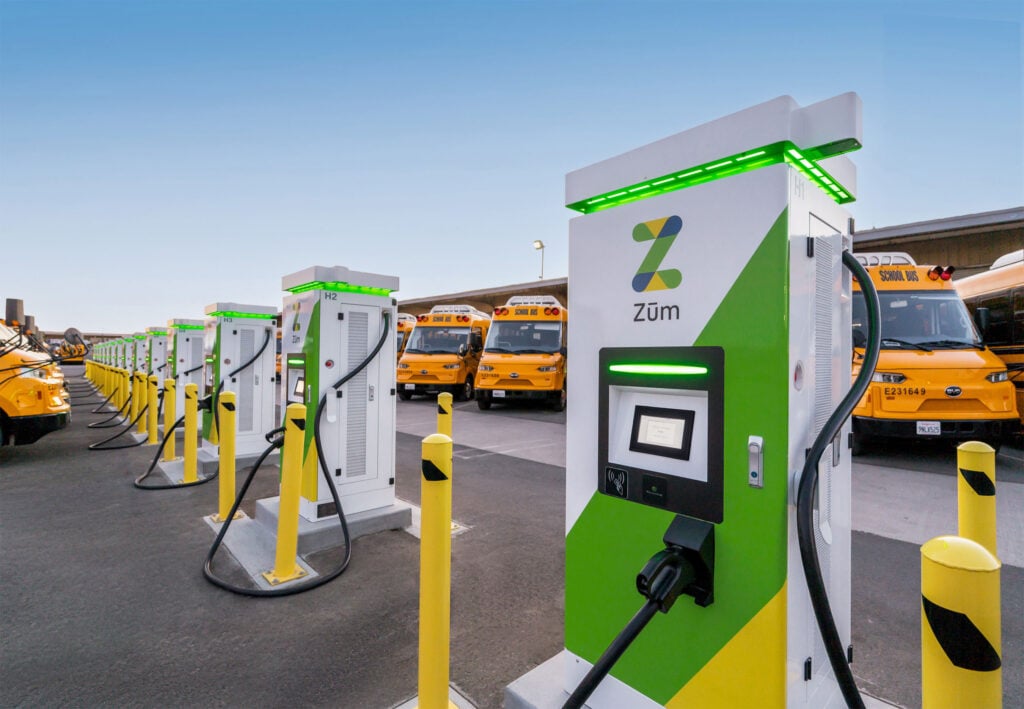
The project pairs vehicle-to-grid chargers built by Tellus Power, a charging equipment manufacturer based in Irvine, California, with 74 buses operated by Zum. Tellus CEO Mike Calise and CTO Srikanth Kanaparthi met with Electrek for a tour of the company’s facility. Tellus has manufactured alternating-current and direct-current chargers, up to 480 kilowatts, since 2010. The company assembles the units domestically and they meet “Build America Buy America” requirements.
The 74-bus fleet carries a combined 11.5 megawatt-hours of energy storage. Buses charge overnight, expend roughly 20% to 40% of their charge during the school day, then plug into the vehicle-to-grid chargers after routes are done and discharge into the grid during the late-afternoon demand peak. On holidays and during summer, when California grid stress is highest, the buses are available as a grid resource all day. The fleet can discharge at about 2 megawatts simultaneously; with average residential evening consumption running around 2 kilowatts per home, the 74 buses can collectively power around 1,000 homes.
Over the two-year operating period, the fleet returned 1.7 gigawatt-hours of energy to the grid and maintained better than 99.5% uptime. Zum purchases power when prices are low and discharges it when prices are highest, a practice known as energy arbitrage that is the source of the revenue stream.
Tellus said a fleet vehicle-to-grid depot can be deployed in months rather than the years required to permit, build and interconnect a conventional power plant. The company also said its chargers do not require large on-site transformers, which it said shortens deployment timelines and reduces installation cost.
The Oakland installation is Tellus’s oldest vehicle-to-grid project. Others are operating or under construction: four school buses in Burlington, Vermont; two city bus chargers for Lynch Bus Lines in Burnaby, British Columbia; a pilot at three school district sites for ComEd in Illinois; and a fleet of 104 school buses in San Francisco, California, with plans to scale that deployment to 238 buses.
The California Energy Commission has estimated that vehicle-to-home technology, if broadly implemented, could cut statewide peak demand by up to 5 gigawatts. One reader responding to coverage of the project noted that scaling a similar model to 100 California school districts could represent 200 megawatts of dispatchable capacity.
Tellus says its next target application for vehicle-to-grid chargers is refuse trucks, which the company sees as a natural direction for the technology.