Bakersfield Approves Up to $19.9 Million for Fleet Chargers to Meet California’s Clean Fleets Rule
The energy savings contract with Willdan installs 133 charging ports at seven city facilities for 395 vehicles and pieces of equipment, and council members called it an unfunded state mandate before voting yes.
Source: City of Bakersfield ↗
Bakersfield, Calif., will spend up to $19,922,436 to install charging for its city fleet, after the City Council approved an energy savings performance contract with Willdan Energy Solutions Nov. 18. The project buys chargers, not vehicles, and is meant to keep the city in compliance with the California Air Resources Board’s Advanced Clean Fleets rule for state and local government fleets.
The council voted unanimously, with Ken Weir and Eric Arias absent, but several members objected to the mandate, KGET reported.
What the Contract Buys
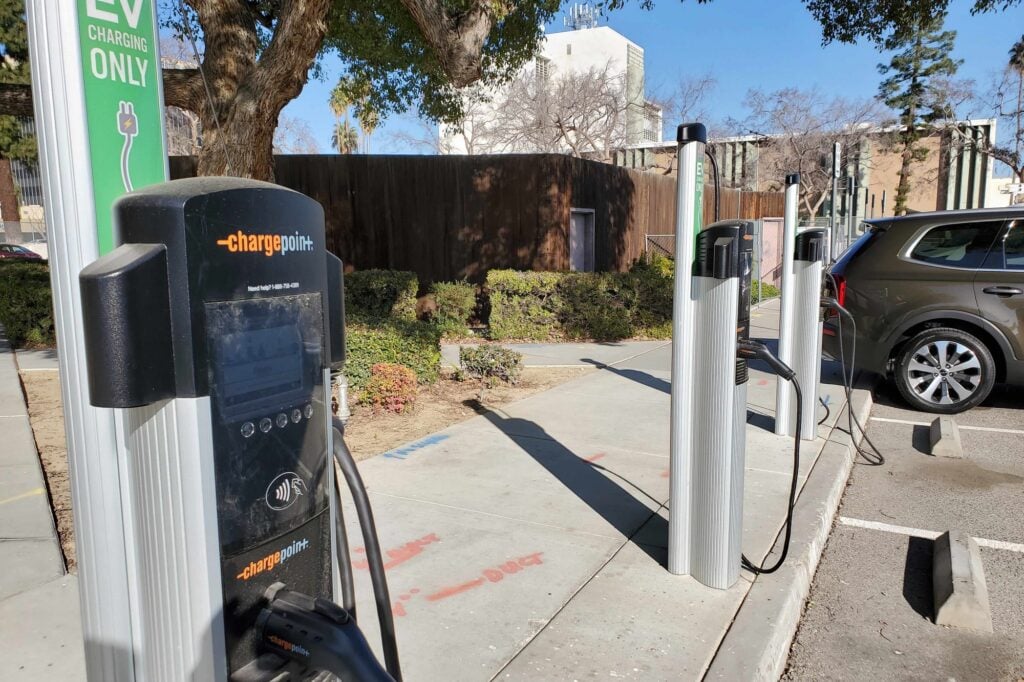
Willdan will install 133 charging ports, 63 Level 2, 69 DC fast and one for a forklift, plus 136 make-ready ports for future chargers, at eight sites at seven city facilities. They include the corporation yard, two wastewater treatment plants, the greenwaste site, the materials recovery facility, the Water Department and a City Hall annex parking area. The chargers will support 395 city vehicles and equipment, including about 320 regulated under the rule, according to the city’s resolution.
The price is a guaranteed maximum, and it covers five years of charger maintenance and networking. Willdan expects to finish construction before the end of 2027, and PG&E is to finish its utility work to the meter before the end of 2028, the staff report says.
Who Pays
The council appropriated $18,922,436 from four funds:
- Solid Waste Fund: $8,263,243
- Equipment Fund: $4,662,996
- Wastewater Fund: $4,346,005
- Domestic Water Fund: $1,650,192
The city has secured $1,572,200 in incentives, $1,422,200 from PG&E’s EV Fleet Program and $150,000 from the local air district, for a net project cost of $18,350,235. Willdan guarantees $331,692 in first-year net energy savings, tied to 97% charger uptime. Staff said the city had to award a contract before December to keep its place in the PG&E program.
Willdan’s audit projects savings of just over $26 million over 20 years, with a return on investment by 2039. Counting the cost of replacing the city’s vehicles and equipment cuts that by $8.8 million, but the cash flow stays positive, staff said. The water and sewer sites show negative cash flow on their own because they have less equipment and use less fuel.
Why Bakersfield Scaled It Back
Willdan evaluated 21 city-owned sites. Its first goal was to future-proof every site for full compliance through 2042, but because of the excessive costs and the need to finance that approach, Willdan cut the scope to enterprise-funded sites, the corporation yard and one downtown facility, staff wrote. The project gets the city compliance through 2033 for Group 1 and Group 2 equipment and through 2036 for Group 3. Police and fire emergency equipment is exempt.
Staff told the council that CARB can penalize agencies up to $10,000 a day for noncompliance and have the DMV withhold new vehicle registrations.
Where the Rule Stands
The state and local government requirements remain in force in an amended version effective Sept. 10, 2026. Starting that day, 50% of a covered public fleet’s vehicle purchases each calendar year must be zero-emission, rising to 100% on Jan. 1, 2030. CARB repealed the rule’s high-priority private fleet and drayage portions, and it has said that during the first reporting cycles it “will focus on supporting compliance on a case-by-case basis as agencies are making good faith efforts to comply,” according to its guidance.
What Council Members Said
“It is very unfortunate that the state is putting this burden of an unfunded mandate on us, but we are where we are,” Mayor Karen Goh said, according to KGET.
Councilman Zack Bashirtash said he didn’t like the project but voted for it. “The state’s telling us we, at certain points in time, have to have a fleet that meets these requirements and that fleet hasn’t even been created yet,” he said.
Vice Mayor Manpreet Kaur said the city would invest in an electric fleet at some point regardless. “We have to spend money on converting to electric anyway and if we don’t have the dollars that help us do that, it will cost us more in the future,” she said.
Quick answers
Is California's Advanced Clean Fleets rule still in effect for government fleets?
Yes. The state and local government requirements of California's Advanced Clean Fleets rule remain in force in an amended version effective Sept. 10, 2026. The California Air Resources Board (CARB) repealed the rule's high-priority private fleet and drayage portions. CARB said that during the first reporting cycles it "will focus on supporting compliance on a case-by-case basis as agencies are making good faith efforts to comply," according to its guidance.