Samsara Launches Fuel Command Center to Help Fleets Control Costs
New platform feature aims to give fleet managers visibility into fuel spend amid price swings.
Source: Samsara ↗
Diesel prices swung more than $0.20 per gallon in a single week seven times since late February 2026, according to Samsara’s Fuel Spend Index, and the latest surge pushed diesel to $5.23 per gallon by the end of July, 16% above where the month began, while gasoline climbed from $3.93 to $4.25. Samsara Inc. (NYSE: IOT) says its U.S. customers carried roughly $2 billion in potential fuel-spend savings in the first six months of the year against that backdrop.
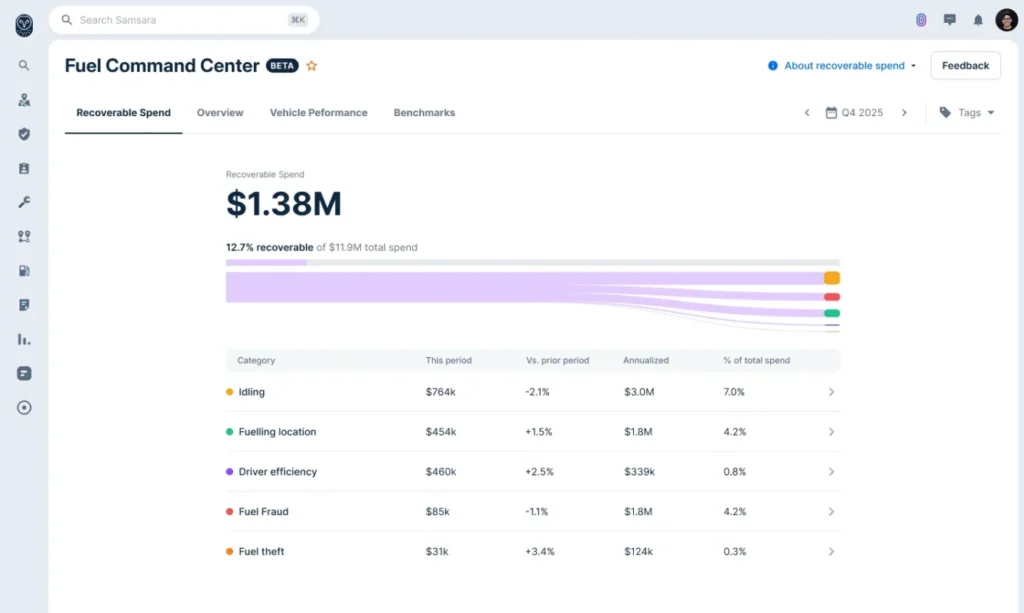
To help fleets capture those savings, Samsara on Aug. 19 launched the Fuel Command Center, a centralized dashboard that pulls fuel usage, driver behavior, routing and card controls into a single view for operations and finance teams. The platform combines a consolidated spend display, intelligent fuel-stop recommendations inside Samsara’s Commercial Navigation tool, and controls for its Coast fuel card integration.
“Fuel is one of the biggest costs a fleet carries— 30% to 40% of total marginal operating costs,” said Ryan Yu, VP of Product at Samsara. “Prices have swung hard the past several months, and when they rise, fuel fraud rises with them. Customers told us pump-price visibility isn’t enough. They need fraud, driver behavior, and vendor choices in one view, so they can cut costs before they add up. That’s why we built Fuel Command Center: to give operators and finance leaders a way to turn their operations data into action and find immediate savings.”
The spend dashboard identifies losses across idling, fueling location, driver efficiency, fraud and suspicious fuel drops, then surfaces the highest-impact corrective actions. Managers can track quarterly trends and act from the same screen, including switching on in-cab idling alerts or adding preferred fuel vendors to an approved list.
Commercial Navigation extends that strategy to the cab by building preferred fuel stops into a route before a driver leaves the yard, removing the need to toggle between telematics and separate fuel-price apps. The tool accounts for corporate negotiated rates, monitors fuel level mid-route and reroutes to the nearest preferred station when needed. In a 90-day analysis of more than 2,000 Samsara customers, organizations cut a median of 4% in fuel spend by fueling at preferred vendors.
On the card side, a Samsara analysis found that detected fraud incidents rise roughly 9% for every $0.10 increase in the price of diesel. The Coast integration addresses that by linking card authorization to vehicle location, blocking transactions when the assigned vehicle is not present at the pump. Kyle Stewart, CFO at Trades Holding, said the results were immediate: “After implementing Coast through Samsara, we saw our fuel expenses drop by nearly $15,000 a month,”
Tim Weisser, Fleet Operations Manager at Milestone Home Services, described the card-control change in operational terms. “We used to worry about fraud all the time. Cards went missing, PINs were shared, and we had no way to verify transactions,” Weisser said. “Now with Coast and Samsara, the system takes care of it. If the truck’s not there, the card doesn’t work. Simple.”
Editor’s note: This industry update was written by Modern Public Fleet staff from an announcement by the supplier or source named above. How we handle supplier announcements