
Fuel Price Report: Diesel Hits $5.97, a 2026 High, as the Middle East Squeeze Tightens Supply
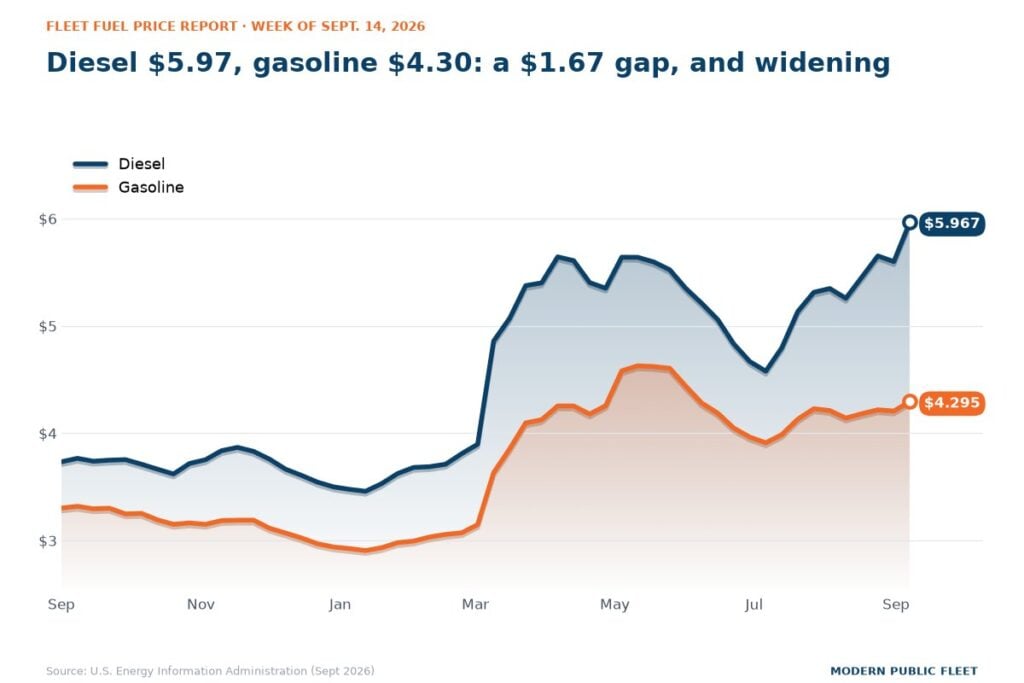
Pump prices jumped 37 cents in a week and sit $2.20 above last year. The fleets not feeling it are the ones running CNG.
 1 / 6
1 / 6
Retail prices as of Sept. 7 · wholesale as of Sept. 9 · inventories for the week ending Sept. 4
- Diesel: $5.97, up 37 cents in a week to a 2026 high and $2.20 above last year. EIA expects it to average about $5.46 through year-end, so no quick relief.
- Gasoline: $4.30, up 9 cents. Flat over three months. Cheapest on the Gulf Coast at $3.79; California $5.79.
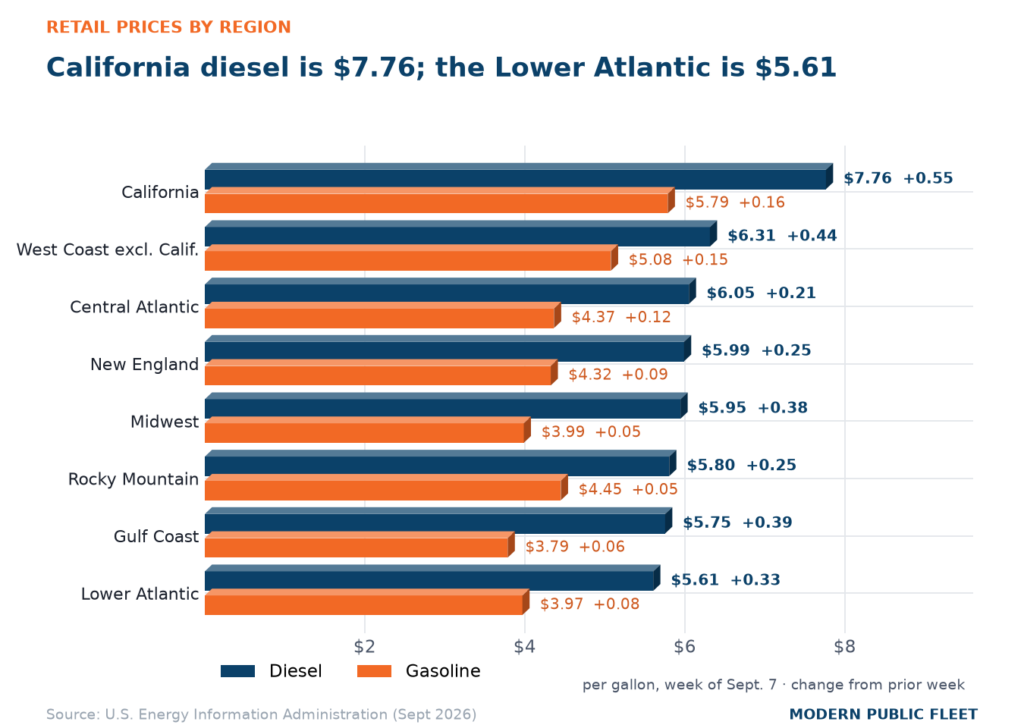
- Regions: Every region rose at least 21 cents. California diesel is $7.76, up 55 cents; the Lower Atlantic is the only region under $5.65.
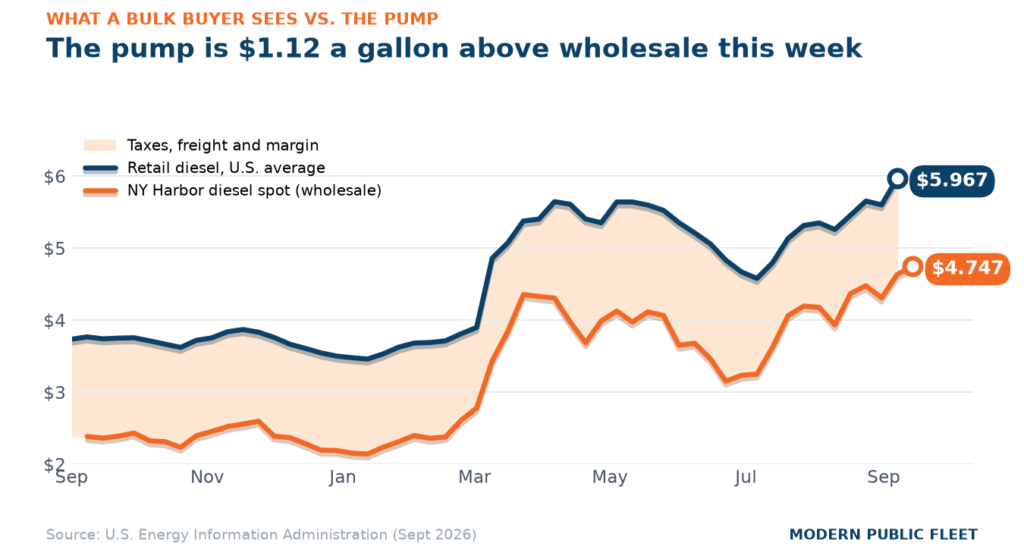
- Bulk buyers: Wholesale diesel is $4.85. The pump is $1.12 above it, so contract fuel is running about a dollar a gallon under card fuel before taxes.
- CNG and propane: CNG was $3.48 per diesel-gallon equivalent in April, $2.07 under diesel then and about $2.49 under it now, and natural gas supply is ample. Propane’s $3.59 sticker works out to $5.53 per diesel-gallon, so autogas pays on a supply contract, not at the pump.
- Why: Middle East exports are still constrained, the U.S. diesel stockpile is 13% below normal and refineries are already at 97.8% of capacity.
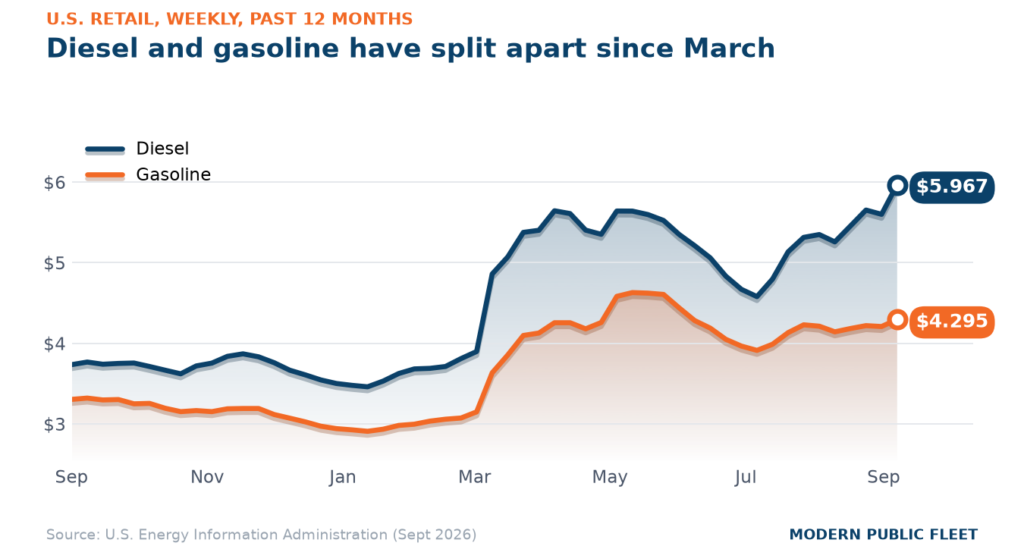
Diesel averaged $5.967 a gallon at the pump in the week to Sept. 7, up 36.8 cents in a week, according to the U.S. Energy Information Administration. That is the highest price of the year and the biggest one-week rise since March. Gasoline rose 8.8 cents to $4.295. A year ago diesel was $3.77 and gasoline $3.32.
The cause is overseas. In its Sept. 9 outlook, EIA said oil is moving through the Strait of Hormuz again but only gradually, that limits on Middle East exports will last through the end of the year and that the region will not be back to normal output until spring 2027. World oil stockpiles have fallen by about 400 million barrels this year. Brent crude, the world oil price that U.S. fuel prices follow, rose to $109.51 a barrel, up $11.92 in a week and about $20 above what EIA assumed when it wrote that forecast six days earlier.
Why it is diesel that hurts
Gasoline is up, but diesel is the problem. The country’s stockpile of diesel and heating oil, which EIA counts together as distillate, is 13% below normal for this time of year even after a small rise last week. EIA expects it to fall below 100 million barrels this month and to stay below its five-year low into 2027. Refineries are already running at 97.8% of capacity, so there is little more to squeeze out, and strong overseas prices are pulling U.S. diesel onto export ships. Demand is not the driver: fuel use is down 3.7% from a year ago.
EIA now expects diesel to average $5.07 for all of 2026 and $4.40 in 2027. It has averaged $4.89 so far this year, so hitting $5.07 means roughly $5.46 over the remaining 16 weeks. That is below today’s price, but it is not a quick reversal.
Rebase the fuel line now. Diesel is 58% above where it was a year ago. A budget built on last September’s $3.77 is short by more than half on every diesel gallon, and EIA’s own forecast says to plan on prices near $5.50, not a return to $4.
Do not wait for the dip to fill storage. If you have bulk tanks, the forecast argues for keeping them full rather than timing a bottom that the agency does not see coming this year.
Where it hurts most
California diesel is $7.764, up 54.6 cents in one week. The rest of the West Coast is $6.314. The Central Atlantic is over $6, New England a cent under it, and the Midwest, where most heavy public works fleets run, is $5.946. The Gulf Coast, usually the cheapest diesel in the country, rose 39 cents to $5.754. The Lower Atlantic, at $5.605, is the only region under $5.65.
Gasoline is far less dramatic. The Gulf Coast is $3.786 and Texas $3.725, against $5.787 in California and $5.573 in Washington. Every region rose in the week; among the cities EIA tracks, only Cleveland and Denver saw gasoline fall, by 2 cents and 1 cent.
What bulk buyers are paying
Wholesale moved first. Diesel at New York Harbor, the benchmark most supply contracts are priced from, was $4.850 on Sept. 9, up 18 cents in a week. The pump is $1.12 above that. A fleet on a contract indexed to spot or to a rack price is paying about a dollar less per gallon than a fleet on fuel cards, before taxes, and a government fleet that is exempt from the 24.4-cent federal excise tax and its state motor fuel tax is lower still.
Measure your supplier against wholesale, not the pump. Wholesale plus freight and the contract differential is the right yardstick this week; a quote that looks good next to $5.97 can still be 40 cents rich.
Move card fuel to bulk where you can. Any steady volume still bought at retail on fuel cards is paying that $1.12 gap. If you have tank capacity, this is the month the math on a delivered contract is easiest to make.
The trend: 3, 6 and 9 months
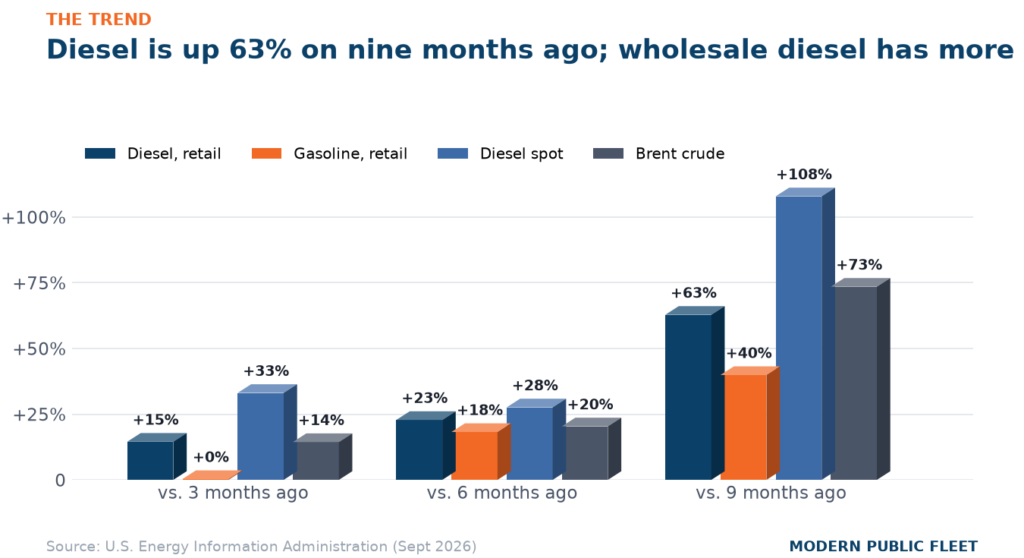
The nine-month picture says this is a diesel story, not a fuel story. Retail diesel is up 63% since mid-December, gasoline 40%. Over three months the split is starker: gasoline is flat, up 0.3%, while diesel is up 14.5% and wholesale diesel 33%. Wholesale diesel at 108% over nine months shows how much of the increase has not yet reached the pump.
CNG, propane and the other fuels
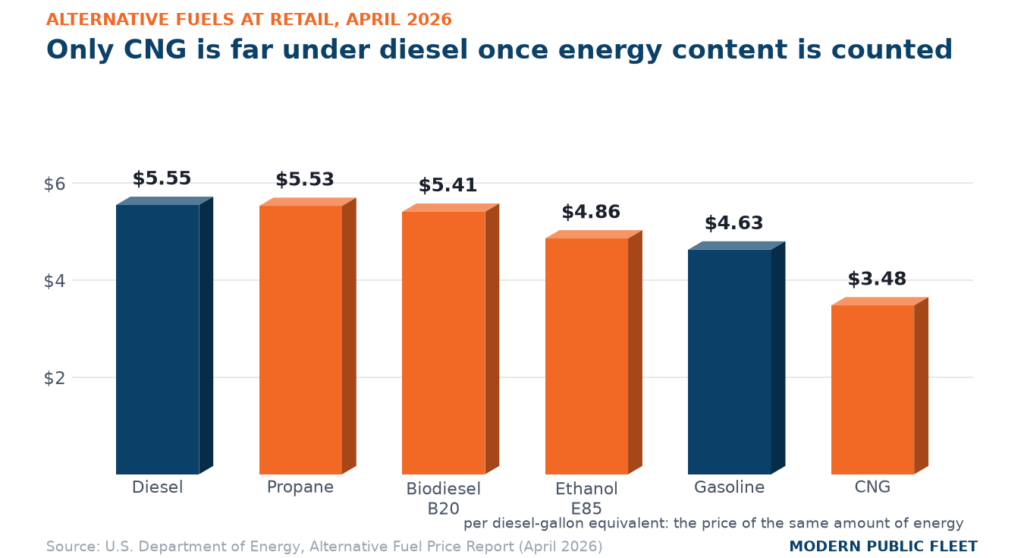
Compressed natural gas averaged $3.48 per diesel-gallon equivalent in April, according to the Department of Energy’s quarterly Alternative Fuel Price Report, when diesel was $5.55. Diesel is now $5.97. Natural gas has stayed put: EIA expects storage to end the season 5% above normal, which points to flat CNG costs through winter. Propane autogas was $3.59 a gallon at retail in April, but a gallon of propane holds about two-thirds the energy of a gallon of diesel, so on DOE’s energy-equivalent basis it cost $5.53, within 2 cents of diesel. The saving in propane is in the contract: the wholesale price at Mont Belvieu, Texas, is 83 cents and inventories are 27% above normal, and fleets buying on contract pay far closer to that number than to the retail one. Biodiesel offers no escape: B20 is 80% diesel and moves with it. E85, at $3.31 a gallon, works out to $4.86 per diesel-gallon once its lower mileage is counted.
Re-run the CNG payback with this week’s numbers. Per diesel-gallon, the CNG saving has widened from $2.07 in April to roughly $2.49, if CNG has held near its April price. A truck that burns 8,000 gallons of diesel a year is now saving about $20,000 a year on fuel alone. If a replacement decision was close on price last spring, it is not close now.
Propane fleets: check your contract against 83 cents. At retail, propane is no cheaper than diesel once energy content is counted; the saving lives in the contract. The retail-to-wholesale gap in propane is wider than in any other fuel on this page, and DOE’s own note says contracted fleets pay significantly less than the retail figure.
What to watch this week, and what it tells you
-
Every weekdayWholesale diesel at New York Harbor
This is the price your supplier pays before freight and margin, and it moves one to two weeks ahead of the pump. It rose 18 cents last week, which is why we expect another increase at the pump on Monday. When it falls for two or three days in a row, that is your first real sign that retail relief is coming; when it keeps rising, it is not.
-
Monday, 5 p.m. ETEIA’s weekly pump prices
The national and regional averages in the charts above. A third straight weekly rise would put diesel above $6 nationally for the first time since 2022.
-
Wednesday, 10:30 a.m. ETEIA’s weekly inventory report
The one number to look for is the diesel stockpile, listed as distillate, compared with its normal range for the week. It is 13% below normal now. If it falls again, the squeeze is still on; if it rises by a few million barrels, that is the earliest sign of loosening. The report also shows refinery utilization, which at 97.8% has no room left to help.
-
Oct. 6EIA’s next monthly outlook
The first forecast written with this month’s crude jump in it. If EIA raises its 2026 diesel average again from $5.07, budget assumptions built on the current forecast need to move with it.
Glossary: how to read fuel prices
This note runs with every Fleet Fuel Price Report because these prices measure different things, and a buying decision made off the wrong one is expensive.
- Retail
- The pump price. EIA surveys stations every Monday. It includes federal and state taxes, freight to the station and the retailer’s margin, and it lags the wholesale market by one to two weeks. It is what a fleet pays on a fuel card, and it is the number most news reports quote.
- Wholesale, or spot
- Today’s price for a large lot of fuel at a trading hub: New York Harbor, the Gulf Coast or Los Angeles. EIA publishes it every business day. Rack prices and most supply contracts are set off it, and it is the earliest public signal of where the pump is heading.
- Futures
- A price agreed today for delivery in a future month, traded on the New York Mercantile Exchange. The nearest month tracks spot. The useful part is the shape of the curve: when later months are cheaper than the front month, the market expects today’s tightness to ease; when later months cost more, it expects the opposite. A fleet does not buy futures, but a fixed-price or capped supply contract is priced off them, so the curve is what your supplier is looking at when it quotes one. Futures settlements are published by CME Group and are not free to republish, which is why they are described here rather than charted.
- Bulk
- What a fleet pays a supplier for delivery to its own tanks. It is usually a published rack price, most often OPIS, plus or minus a differential and freight, or spot plus a differential. It excludes station margin, and for state and local governments it usually excludes the 24.4-cent federal excise tax on diesel and the 18.4-cent tax on gasoline, along with state fuel tax where the state exempts government use. Rack prices are proprietary, so there is no public bulk series. The gap between spot and retail is the closest public measure of what a bulk buyer avoids.
- Brent crude
- The price of a barrel of oil from the North Sea, used worldwide as the reference price for crude. Diesel and gasoline are made from crude, so when Brent moves, wholesale fuel follows within days and the pump within weeks. It is quoted in dollars per barrel; a barrel is 42 gallons.
- Energy-equivalent prices
- A gallon of propane, E85 or CNG does not hold a gallon of diesel’s energy, so DOE also states alternative fuel prices per gasoline-gallon equivalent (GGE) and per diesel-gallon equivalent (DGE). That is the price of the same amount of work, and it is the only fair way to compare a CNG or propane quote with a diesel one. The alternative fuels chart in this brief uses it.
- What it means for buyers
- Watch spot for direction: a rising spot price this week is a higher pump price next week, and vice versa. Use the curve for planning: when later months are much cheaper, locking in long at today’s price is expensive insurance; when the curve is flat or rising, a fixed-price contract costs less to get. And judge any supplier quote against spot plus freight, never against the pump.
Source: U.S. Energy Information Administration (Sept 2026), Gasoline and Diesel Fuel Update, Spot Prices, Weekly Petroleum Status Report and Short-Term Energy Outlook; U.S. Department of Energy, Alternative Fuel Price Report (April 2026); IRS Publication 510. EIA and DOE data are U.S. government works in the public domain. Charts by Modern Public Fleet from those sources.