Miami Modernizes From the Inside Out
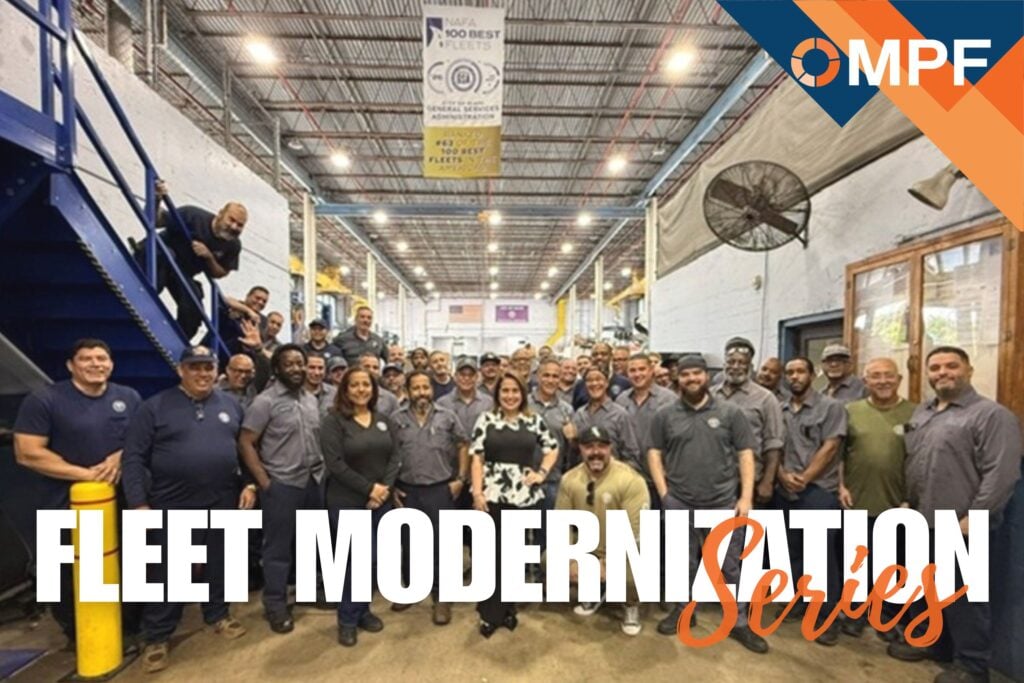
When Miami’s fleet team began tackling its aging operation, the biggest problem was hard to miss. Some solid waste trucks designed for an eight- to 10-year useful life were still working at 17. Police vehicles expected to serve about seven years had reached 10 or 11.
Finding parts had become difficult enough that technicians and welders sometimes had to fabricate their own solutions to keep equipment running. “We got really creative with some of these repairs,” Jennifer Ramirez, director of the City of Miami General Services Administration (GSA), said. “You can look at some of these garbage trucks and if you look inside, it’s like Frankenstein.”

At times, she said, welders would put their heads together and figure out how to adapt or reposition components to make a repair work. “Mechanical engineering at its best,” Ramirez said.
But Miami didn’t begin its modernization by trying to replace everything. The fleet team first turned its attention inward, addressing the processes, technology and working conditions it could improve without massive capital investment. That approach eventually helped Miami build a stronger case for the money it did need.
Clean up the operation first
Miami’s light-duty operation includes approximately 3,000 vehicles, about 1,620 of them police units. Fleet also supports roughly 3,500 pieces of small equipment and another 450 to 500 pieces of heavy equipment, including solid waste trucks, backhoes, cranes and bucket trucks. The city repairs and maintains it all in-house.
Ramirez said the team essentially separated its challenges into 1) internal problems it could address and 2) the aging fleet, which would ultimately require substantial funding. “We started looking at things that we could standardize in our operations,” she said. “We began establishing clear workflows and clearing the immediate repair backlog.”
The team then examined parts inventory and how better information could help ensure parts were on hand before scheduled service. “Once we paid attention to all of these in-house functions, we found the focus to then try to get the capital we needed to replace our aging fleet,” Ramirez said.
Michael Brennan of CDMB Consultants, who has watched the Miami operation’s progress, sees that attention to the fundamentals as an important part of the turnaround. He said Miami’s gains haven’t come from one sweeping change, but from individual improvements beginning to work together across the operation.
For fleets with modernization needs that far exceed their available funding, Miami’s sequence offers a useful starting point: Separate what requires major capital from what can be improved now, then start building results.
Make the systems talk
Technology was one of those opportunities. Miami had used Faster as its fleet management provider for more than 20 years, but the company’s move to a web-based platform meant a substantial change for the city. “That’s not just a transition. That’s like a new re-implementation,” Ramirez said.
The fleet worked closely with Faster through the process, including addressing technician feedback and gaps that emerged during implementation. Meanwhile, Miami brought in Samsara for GPS and telematics and integrated the two platforms. “Now we have both platforms speaking, giving my technicians this information in real-time,” Ramirez said.
The integration helped solve a particular problem with police vehicles. Because police units could fuel outside the city’s normal fueling system, fleet sometimes lacked current mileage information. Engine hours were another important blind spot because the vehicles spend considerable time idling.
Now the operation can monitor both and alert departments when a vehicle reaches its PM threshold. “We’re able to actually capture the engine hours and the mileage, and if they hit a certain cap, it gives us an alert,” Anthony Barcena, Assistant Director of GSA, explained.
Miami also changed where technicians access that information. Mechanics previously shared workstations in the garage and sometimes waited for one to become available.
With web-based systems, the city equipped technicians with tablets. “They all have their independent workstation at their bay in their hands,” Ramirez said.
Listen to the shop
Some of Miami’s most practical modernization projects were considerably less high-tech.
The city replaced aging lifts on the light-duty side, in part to prepare for EVs after Miami began testing six Teslas. Employees participated in evaluating lift options before the final selection.
The fleet also replaced workbenches that Barcena described as “falling apart, rusty.” The new benches have electrical outlets, giving technicians places to power tablets and tools without extension cords stretched across the shop.
Many of those ideas came from management spending time with employees. “We thought the working stations were fine until they spoke up,” Barcena said. That feedback loop is an intentional part of Miami’s management approach.
“That face time is non-negotiable,” Ramirez said. “How do you have employees want to work for you if you don’t see them?” She sees the workplace itself as part of the equation: the environment, tools, cleanliness and procedures. “But it’s also your people,” Ramirez said. “If they see you, then they know that you see them.”
That philosophy extended to something as basic as taking lunch. The mechanics’ break area had doubled as the customer lounge, meaning employees could find themselves fielding questions about vehicle repairs while trying to eat.
In response, Miami built a separate employee recreation and break room, complete with couches, a TV, exercise equipment and ping-pong and domino tables. “It sounds silly, but the morale just goes completely up when you invest in that,” Barcena said of the shop improvements.
Find money in the process
Assistant Director of GSA Marcia Lopez’s work on parts and procurement illustrates another path to modernization that doesn’t begin with a large capital appropriation. “We went from a reactive parts management approach to a more proactive one,” Lopez said. “We are anticipating the parts requirements and improving availability.”
The change helped reduce bay delays and technician turnaround time. Fleet also worked with procurement to expand its qualified vendor pool. That created “a more competitive environment,” Lopez said, which helped improve pricing, availability and service. Ramirez added that the larger vendor pool sometimes produces what amounts to a reverse bidding war, with suppliers lowering their prices to compete for fleet’s business. “And that helped us free up some of our operating money,” she said.
Brennan sees Miami’s procurement work as more than a back-office improvement because parts availability ultimately shows up in shop performance. “If the vehicle is sitting in the bay waiting for a part, nobody wins,” he said. “What Miami is doing on the procurement side directly supports what’s happening out on that shop floor.”
Lopez also focused on paying vendors more quickly and consistently. The improved payment cycle strengthened vendor relationships, she said, supporting parts availability and faster turnaround. For another fleet, the lesson is to widen the modernization lens. Procurement, vendor management and accounts payable can impact what happens in a maintenance bay just as much as a new piece of shop equipment.
Build for the bad day
As Miami improved its systems, another weakness became apparent: fuel. The city updated its Gasboy program and examined its physical fueling infrastructure. Its tanks held 15,000 gallons each, which meant an operation of Miami’s size was receiving fuel deliveries about every other day. “That’s just too close to shave,” Ramirez said.
A previous South Florida storm had disrupted the region’s ability to move fuel, demonstrating how quickly a supply problem could become an operational one. Miami increased each tank from 15,000 to 27,000 gallons. “We basically doubled our capacity,” Ramirez said. “And now we can run our operation without a fuel delivery for an entire week.”
For Miami, that is a modernization investment with a uniquely local purpose. “We have to worry about storms,” Ramirez said. “We have to worry about the port not being able to get to us.” Other public fleets may face threats of a different nature, but the question is transferable: How long can the operation keep serving the public when a critical outside resource suddenly becomes unavailable?
Turn results into investment
Miami eventually had measurable evidence that its smaller changes were working. Ramirez said fleet downtime declined, daily asset availability became more consistent with targets and PM compliance improved. Better data meant vehicles could come in based on engine hours as well as mileage.
Brennan said those results reflect the cumulative effect of the work Miami had been doing across the operation. Better information, working conditions, processes and technician support began reinforcing one another rather than functioning as separate modernization projects. “There’s no single project that suddenly makes a fleet efficient,” he said.
“We saw the improved turnaround time, too, because now trucks or vehicles aren’t coming in because they’re broken,” Ramirez said. “They’re just coming in ahead of time to be serviced to avoid the breakdown.”
Those results strengthened fleet’s case with city leadership and elected officials. Ramirez could show improvements in areas the department controlled before asking the city to address what it couldn’t solve operationally: an aging fleet.
The city ultimately secured a renewable $150 million line of credit. Its structure will allow Miami to revisit funding as vehicles are paid down rather than waiting until equipment is well beyond its useful life before beginning the replacement conversation again.
Financing, Ramirez said, was “by far” the biggest hurdle. By the time Miami asked for that investment, however, Fleet could point to the operational improvements it had already made and the results they were producing. Then use the resulting improvements to build credibility for larger investments.
“You can only clean house so much,” Ramirez said. “We did it with the technology. We did it with the tools. We did it by increasing our infrastructure. But I still have 17-year-old trucks and 11-year-old cars.”
The old vehicles hadn’t gone anywhere. What had changed was the operation around them, and Miami now had the results to make the case for replacing them. “I couldn’t sell that if my house was not in order,” Ramirez said.