Cargo Vans and Work Pickups Struggle in IIHS Crash Avoidance Tests
New IIHS ratings show commercial vehicles lag behind passenger cars in front crash prevention
Source: IIHS-HLDI crash testing and highway safety ↗
Commercial vehicles, long exempt from safety standards applied to passenger cars, are now showing the gap in a new round of crash avoidance ratings from the Insurance Institute for Highway Safety (IIHS), and most cargo vans and heavy-duty work pickups are not measuring up.
“These results are a wake-up call for commercial vehicle makers,” IIHS President David Harkey said. “Front crash prevention is especially important for these larger, heavier vans and trucks because of the danger they pose to other road users.”
In 2024, 6,215 people were killed in crashes involving heavy- or medium-duty vehicles or light vans, accounting for 16% of all roadway fatalities in the U.S. Reducing that toll is a key part of the Institute’s 30×30 vision of reducing fatalities 30% by 2030.
IIHS launched its commercial vehicle assessment program in June with a driver protection evaluation covering standard front and side airbags, advanced seat belt technology and seat belt reminders. Many government standards that apply to passenger vehicles, including airbag requirements, do not extend to delivery vans, box trucks, tractor-trailers and larger work pickups. The new front crash prevention ratings use the Institute’s full four-tier scale of good, acceptable, marginal or poor, with test protocols identical to those used for passenger vehicles.
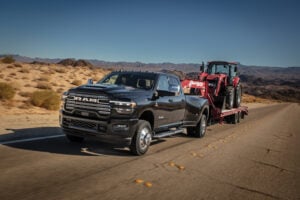
The initial round covers cargo vans and Class 3 pickup trucks, defined as vehicles with a gross vehicle weight rating (GVWR) of 10,001 to 14,000 pounds. The GVWR is the maximum weight a vehicle can carry safely, including passengers, cargo and the weight of the vehicle itself. IIHS will add headlight and rear automatic emergency braking ratings for Class 3 vehicles this year and next; testing of Class 4-6 trucks will be phased in after that.
Front crash prevention ratings: cargo vans and Class 3 pickups
| Vehicle | Type | Vehicle-to-vehicle | Pedestrian |
|---|---|---|---|
| 2025-26 Chevrolet BrightDrop 400 | Cargo van | Acceptable | Good |
| 2025-27 Chevrolet Express 2500 | Cargo van | Poor | Poor |
| 2025 Ford Transit T250 | Cargo van | Poor | Marginal |
| 2025-27 GMC Savana 2500 | Cargo van | Poor | Poor |
| 2025 Mercedes-Benz Sprinter 2500 | Cargo van | Good | Acceptable |
| 2025-27 Ram ProMaster 2500 | Cargo van | Poor | Marginal |
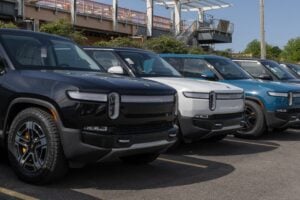
| 2025 Rivian RCV-Delivery 500 | Cargo van | Marginal | Good |
| 2025-26 Chevrolet Silverado 3500HD | Class 3 pickup | Poor | Marginal |
| 2025 Ford F-350 | Class 3 pickup | Poor | Acceptable |
| 2025-26 GMC Sierra 3500 | Class 3 pickup | Poor | Marginal |
| 2025-27 Ram 3500 | Class 3 pickup | Marginal | Acceptable |
Source: IIHS.
The top performers across both tests are cargo vans. The Mercedes-Benz Sprinter 2500 earns a good rating for vehicle-to-vehicle front crash prevention, and the Chevrolet BrightDrop 400 and Rivian RCV-Delivery 500 earn good ratings for pedestrian crash avoidance.
The Chevrolet Express 2500 and GMC Savana 2500 earned poor ratings in both tests because neither is equipped with automatic emergency braking; each is available with an optional forward collision warning system only. The motorcycle target proved the hardest element of the vehicle-to-vehicle test across the group: several systems issued no warning and made no reduction in speed through most motorcycle trials, while others slowed effectively but were downgraded for failing to warn the driver in time.
Vehicles generally fared better in the pedestrian evaluation than in the vehicle-to-vehicle test. The pedestrian protocol covers daytime and nighttime scenarios with an adult crossing, a child crossing and an adult in the travel lane. Several vehicles, including the acceptable-rated F-350 and Ram 3500, had more difficulty detecting a child in daylight than an adult at night, a result IIHS attributed to the shorter stature of the child target relative to the tall front ends of the vehicles and the sensor placement near the rearview mirror. In some runs the child dummy registered at distance and then dropped out of detection as the vehicle closed. Poor and marginal systems also failed to brake sufficiently in most nighttime adult trials, with some performing substantially worse on low beams than high beams, and some doing worse at the lowest test speed than at higher ones.